|
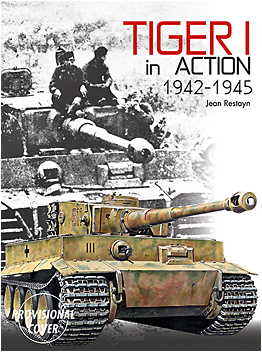
TIGER I in Action
1942 - 1945 In April 1941, two months prior to
operation 'Barbarossa,' Adolf Hitler ordered the development of a heavy tank, armed with the famed 88 mm gun. This tank became
a legend in its own time. Feared by its adversaries and liked by its crews, the Tiger etched its mark in history and the legend
carries on, 60 years after the end of the war.
This compilation of the two volumes dealing with Tiger units on the Eastern
front, the Western front, and Africa, features almost a thousand period pictures, mostly unpublished, and more than 80 full-color
plates by the author: tank profiles, details of markings and insignia, camouflage, and a short history of each Tiger unit.
This edition has been revised and augmented, with more accurate captions as to dates and locale, together with new illustrations
and a chapter on additional units. Size: 9"x12", Pages: 288, Over 1,000 B&W wartime photos. Price - $52.95
If you are interested in military history, if you are a collector and military re-enactor, then stop right here. We are
proud to offer the finest military books on the market . If you don`t see a particular book, lets us know
and we can get it for you.
New
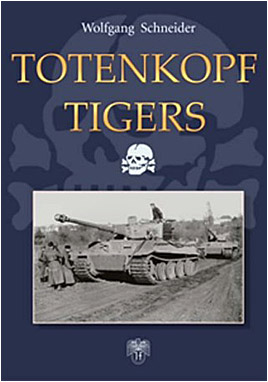
TOTENKOPF TIGERS
Written by Wolfgang Schneider, one of the foremost experts on WW II armour warfare,
"Totenkopf Tigers" is the history of the Tiger Company of the 3.SS-Panzer-Division Totenkopf. In the fall of 1942, a heavy
Tiger company was formed for each of the Leibstandarte Adolf Hitler, Das Reich and Totenkopf SS-Panzer-Grenadier Divisions.
While each of the Tiger companies of the other two divisions was used to form an independent Tiger battalion, the Totenkopf
company remained as a company with its division until the end of the war. It used the Tiger I exclusively, never being issued
the Tiger II.
Totenkopf Tigers participated in the retaking of Kharkov in early 1943, Operation
Zitadelle in July and at the Mius in late July and August. The division withdrew behind the Dniepr at the end of September
and fought at Ingulez at end of October and Kirovograd in January 1944. The company broke out toward Balta at the end of March
and crossed into Romania at the beginning of April.
It remained there, taking on new tanks, until the end of May 1944. It fought around
Targul Frumos until beginning of July. The Totenkopf was then transferred to Poland, where it fought near Grodno in Mid-July.
It was a part of the whirlwind battle east of Warsaw and two of its Tigers even became involved in the Warsaw Uprising in
August 1944 when they were passing through the city on their way back to their unit. The Totenkopf company was then transferred
with its division to Hungary, where it participated in the three offensives to relieve Budapest. It then withdrew through
Hungary and Austria, losing its remaining tanks along the way in bitter defensive fighting. Its men then fought as infantry
armed with panzerfausts.
It surrendered with its division to the Americans on May 8, 1945. Its men were then
handed over to the Russians, many of whom did not return to Germany until 10 years later. Of the more than 500 men who served
in this unit, approximately half were killed, wounded or taken prisoner. The company was almost in continuous battle for two
and a half years, all of it on the Eastern Front. Long overdue, here is their story. Hardcover, large format, 320 pages,
448 photos, 55 maps, 16 pages of color profiles. (rzm) Price - $90.00
New
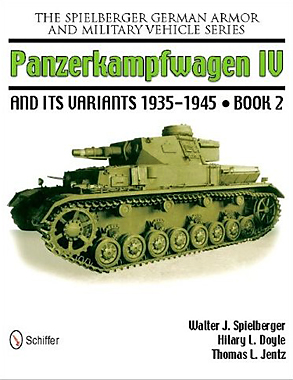
Panzerkampwagen IV and its Variants
1935-1945 Book 2
This book is the final documentation on the Panzerkampfwagen IV series, the most
often-built German tank of World War II and presents the exact chronology of the vehicles development from 1935-45, plus many
hitherto unknown and pioneering test vehicles. The authors discuss the origin of the "Large Tractor", the so-called Neubau
(New-Built) Vehicle and the attempts in 1944 to install the 7.5 cm Kampfwagenkanone 42 L/70 of the "Panther" onto the Panzer
IV. The authors have dedicated an entire chapter to armament, and action in all war theaters. Hardcover, 8.5" x 11", 304
pages, Over 400 B+W photos. (rzm) Price - $69.99
New
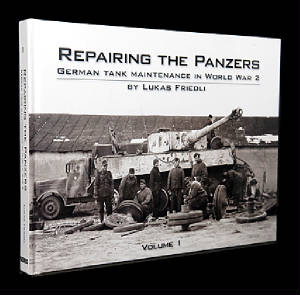
Repairing The Panzers Vol. 1
German Tank Maintenance in World War 2
How did Germany keep its infamous Panzers running throughout six years of war? How did the German army prepare
for motorized warfare? What mechanic was competent for what kind of damage? What special vehicles and recovery equipment were
used by the maintenance units? How were they organized? How much supply reached the front during Operation 'Zitadelle' and
how was it distributed among the battered divisions?
The answers to these and other questions are to be found here
in this book. Based solely on original experience reports, diaries and manuals, you will learn how Panzers were recovered
from various predicaments and what really put Panzers out of action. For the first time ever you will get an inside look at
the battle that went on behind the front lines to keep every Panzer possible in fighting condition.
Panzerwrecks are
proud to present these new discoveries in a massive 256 page tome illustrated with 291 large format photos, most unpublished
and reproduced full-page size, plus 17 drawings, 5 diagrams, 19 tables and 17 K.St.Ns.
Chapters:
1. Overview and Background,
2. I-Dienste of the Field Troops
3. The Panzer Werkstatt
4.
Armee, H.Gr. and the Homeland
5. Wheeled Vehicle Maintenance
6. Campaign Experience
7. Causes
of Panzer Losses
Appendix (inc. Index and Glossary
hard cover, 11" x 8.5", 256 pages, 291 photos, 17 drawings, 5 diagrams, 19 tables.
Price - $54.95
New
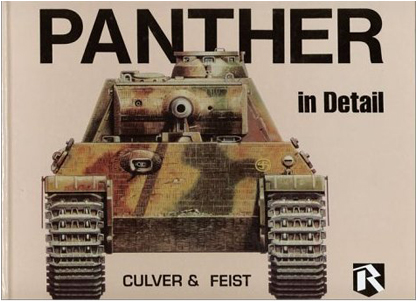
Panther in Detail
This release from Ryton publishing covers all aspects of the Panther Tank, all productions models are shown
in cluding the Bergpanther recovery vehicle. It has brilliant color plates drawn by Uwe Feist, along with an excellent mix
of wartime and present day museum shots. This is an excellent book that modelers will want. Hard cover,
12" x 9", 181 pages, hundreds of color and b+w photos.
Price: $49.95
New
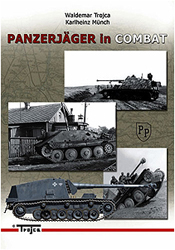
Panzerjäger in Combat Vol.1
The first volume in a three part series. Contains 344 pages, including 72 pages of color line drawings and
3D drawings, 260 photographs, and 354 2D/3D b+w drawings. The volume covers the following vehicles: Panzerjager I, All vehicles
referred to as Marder, based on the chassis of the Pz.Kpfw.II and Pz.Kpfw.38 (t) tanks, that is, Sd.Kfz. 131, Sd.Kfz. 132,
Sd.Kfz. 139, Sd.Kfz. 138 (Ausf. H and Ausf. M), Hetzer, Hornisse (Nashorn), The prototype vehicle 10.5 cm Pz.Sfl.Iva. Price:
$115.00
New
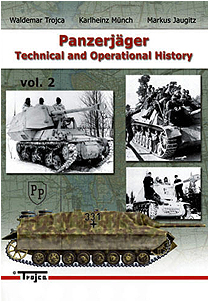
Panzerjäger in Combat Vol.2
The second volume in a three part series. Will contain approximately 340 pages, including 80 pages of color
profiles and 3D color drawings, 250 photographs, and approximately 350 2D/3D B & W drawings. The volume will cover the
following vehicles: All Marder vehicles based on the chassis of captured French tanks, Panzerjäger IV, Panzer IV/70 (V),
Panzer IV/70 (A), RSO (with the 7.5 cm Pak 40/4 gun), Various Waffentäger. Improvised vehicles based on the Demag D 7 halftrack
(Sd.Kfz. 10), the Krupp L 3 H 143 truck and other captured English and Russian half-tracked vehicles. Price:
$TBA Coming Late 2009
New
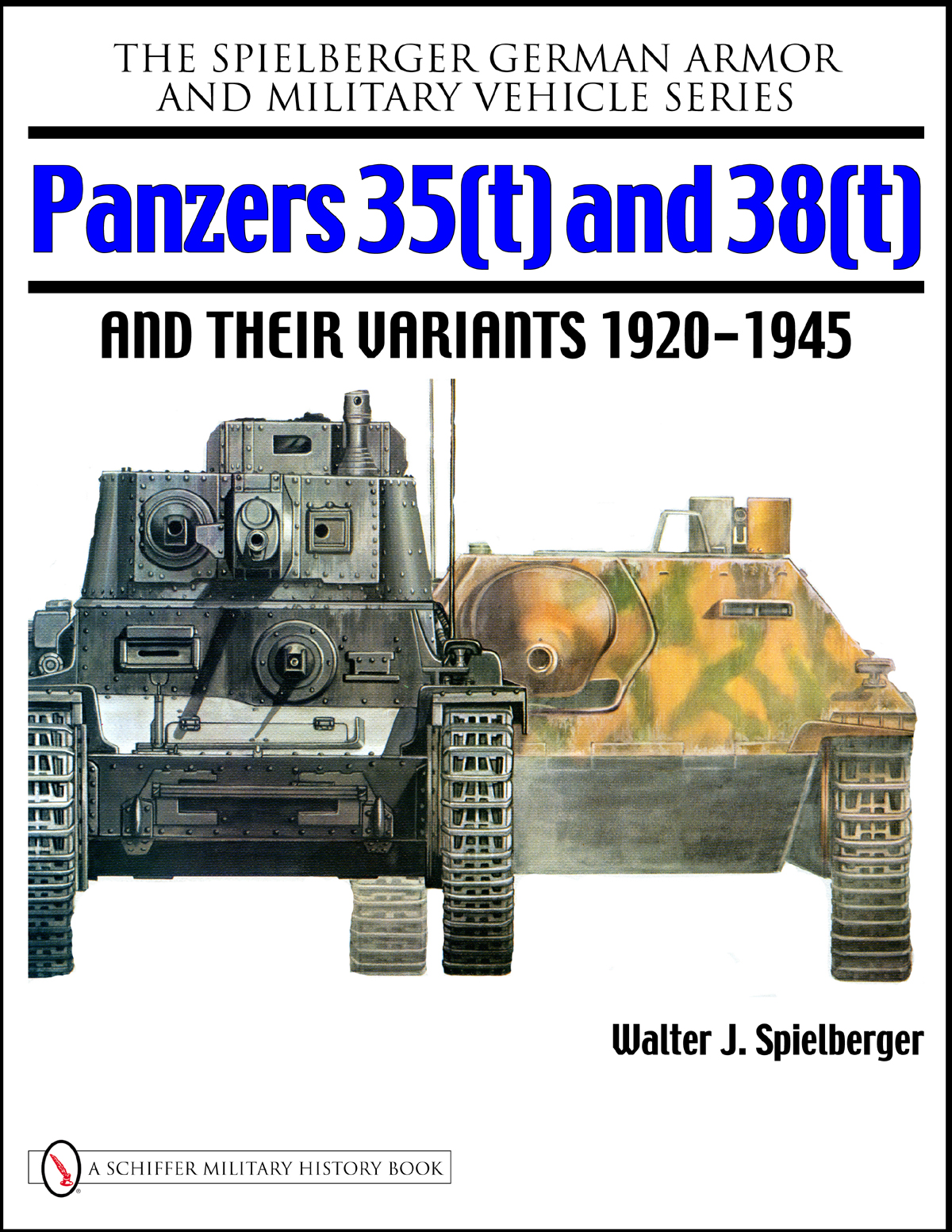
Panzers 35(t) and 38(t) and their Variants 1920-1945
This classic, definitive series continues with this volume on Czech panzers and armored vehicles in German
use from 1920-1945. Spielberger, a leading expert in the field of German military vehicles, presents the wide variety of variants
on the 35(t) and 38(t) chassis: self-propelled artillery, anti-tank guns, flak, mortars, flamethrowers, Hetzer, half-tracks,
trucks, personnel carriers, etc.
Hard Cover, 8.5" x 11", 176 pages, over 600 b+w photos, line drawings.
Price:$69.99
New
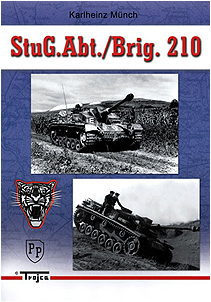
Sturmgeschütz-Abteilung/Brigade 210 in Combat
The "Tiger's Head" Brigade
A detailed visual account of the history of this brigade.
Hardcover, 320 pages, 430 photos, 16 pages of color (with many in 3D effect).(rzm) Price: $105.00
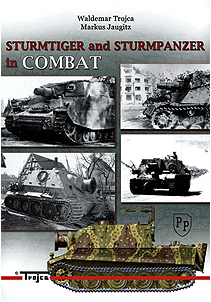
New
Sturmtiger and Sturmpanzer in Combat
Covers assault tank variants (initial efforts), Stupa IV and the Sturmtiger. Lots of superb color (a la the King Tiger
book) and the usual other graphic niceties!
Hardcover, 250 pages, 80 pages in color, 220 photos, 30 pages of text, maps and organigrams. (rzm) Price: $110.00
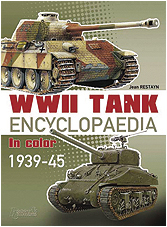
New
WWII Tank Encyclopaedia in Color 1939-45
Ten years ago, Histoire & Collections published a book entitled Tanks of World War Two, which comprised
hundreds of color profiles and three-quarters views by Jean Restayn. This book obtained a great success but is now sold out
for long.
The time has come of publishing a completely renewed version, with many additions. In this volume, campaign
by campaign, the proper tanks (battle tanks and light tanks as well) of every nation involved in the various campaigns of
W.W.II, from Poland to Berlin and from Libya to Normandy, from the earliest Panzer I to the latest British Cruiser tank, each
type is represented in full color.
Two additional volumes are scheduled in this Encyclopedia: Volume Two will be devoted
to tank destroyers, self-propelled artillery and special purpose AFVs, while Volume Three will include the various types of
wheeled armored cars and miscellaneous armored vehicles.
Size: 9" x 12", Hard cover, 128 pages, English text. (rzm)
Price: $59.95
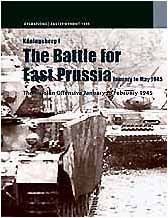
New
Konigsberg:
The Battle for East Prussia
The Russian Offensive: January-February 1945
East Prussia was the first genuine part of the German home lands that fell to the Red Army in 1945.
Already by 1944 some parts of East Prussia had been under the attack of the Soviets. The tragedy became complete in April
1945. The losses and horrors German civilians had to endure were tremendous. The Red Army showed its worst
after the capture of East Prussia. The discovery of the Red Army's behavior in late 1944 in some of the border towns led to
the most severe battles ever to be fought in East Prussia. The German army tried in vain to save the civilians from the Red
Army onslaught. The battle for East Prussia ended with the siege of Konigsberg and Pillau, April 1945.
The loss of human lives during these battles for East Prussia was very high. This book covers a much overlooked
and little recorded campaign during World War Two. It draws on sources from both the Russian archives giving the Red Army
view and those from the German side gives a good balance, and it contains never before seen pictures of the fighting and a
great number of maps and color profiles of the AFVs being employed on both sides in the battle. Hard Cover,
6" x 9", 400 pages, 60 color profiles and 200 b/w photos, 60 color maps. (rzm) Price: $37.95
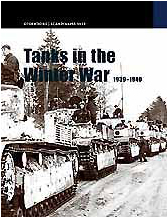
New
Tanks in the Winter War 1939-1945
Operations: Scandinavia 1939
Tanks in the Winter War is a unique book. Certainly there have been shelves of books
written about the Winter War, but none have described the Soviet units and their efforts, and none have described the tanks
used in the conflict. This book is based upon Russian sources and therefore stands out remarkably from other books on the
market about the Finnish Winter War. You are given a concise account of the Soviet units, their equipment and the commanders
and operations. You also get an account of the Finnish defense, the fortifications, the obstacles, the mines and the armours
etc. Furthermore; the only tank battle of the Winter War, the battle of Honkaniemi, is described in detail.
The "Tanks in the Winter War" is a must for all who are interested in what happened in Finland during World War II and is
destined to become a collectors item! Hard Cover, 6" x 9", 160 pages, 32 color profiles, and 130 b/w illustrations and
5 maps. (rzm)Price: $34.95
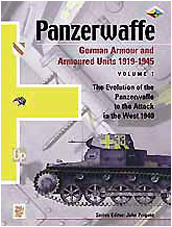
New
PANZERWAFFE:
GERMAN ARMOUR AND ARMOURED UNITS
1939-1945 VOL. 1
The Evolution of the Panzerwaffe to the Attack on the West 1940
East Prussia was the first genuine part of the German home lands that fell to the Red Army in 1945. Already
by 1944 some parts of East Prussia had been under the attack of the Soviets. The tragedy became complete in April 1945. The
losses and horrors German civilians had to endure were tremendous. This is the first book in a new series
of ten titles using the successful and visually appealing format of the Classic Colors series to examine the German Panzer
force from its origins in the immediate post-First World War years through to the end of the Second World War. With clean
and striking design, the series will focus on the campaigns of the German Panzerwaffe in the Second World War and the strengths
and weaknesses of its commanders and operational methods.
Each book will feature a detailed narrative text, describing the planning of each campaign, command and leadership
within the Panzerwaffe, strategy and tactics, analysis of successes and failures, orders of battle, a technical overview of
armored vehicle types and their variants, a focus on key commanders, individual units and theatre aces. The narrative texts
of each book will be written by one or more acknowledged specialists in their field under the coordination of the Series Editor,
John Prigent, himself a renowned expert on the German Panzerwaffe. Each title is supported by around 150 rare and fascinating
photographs, specially commissioned color artwork of the tanks described and pictured, relief-style terrain maps, graphics
illustrating tactics and battles, sidebars and text boxes.
This is an exciting new series which, will apply a fresh and highly illustrated format to this subject matter,
and provide much of interest for those absorbed in the history of mechanized warfare in the last century and offer much practical
help for the military modelers. Future titles in the series will include:- The First World War and the
evolution of the Panzerwaffe 1918-1936- German armor in the Spanish Civil War 1936-1939- Austria and Czechoslovakia, 1938-1939-
Blitzkrieg in Poland, 1939- Assault on Scandinavia, 1940- Attack in the West: the Low Countries and France, 1940. Soft Cover, 8.5" x 12", 96 pages, color and b/w photos throughout. (rzm) Price: $29.95
This title will be available in September. We are now accepting preorders.
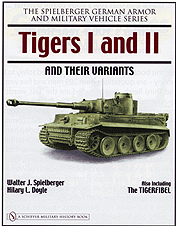
New
Tigers I and II
and their Variants (Includes The Tigerfibel)
The latest volume in the series presents the legendary Tiger and variants including the Tiger II, Jagdtiger,
Elefant, Sturmmorser and others. The Tigerfibel is included in full English translation. Over thirty years of research have
culminated in this volume. Hard Cover, 8.5" x 11", 256 pages, over 500 b+w photos. (rzm) Price:$59.95 !
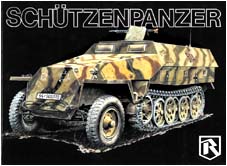
NEW Schutzenpanzer
Back by popular demand! For a limited time only! This outstanding title from renowned Ryton series on armor
is dedicated to the Sdkfz. 250/251 WW II German Half-Track. 230 pages, B/W photos, color plates, line drawings. Price
- $70.00
New
A History of Sturmgeschütz-Abteilung 197
This book must be considered a prequel of sorts to the Combat History of schwere Panzerjäger-Abteilung 653,
which is now out-of-print (although reprinted in a softcover format by Stackpole). Although covered in the latter book, this
new title has scads of new information and -- as you would expect from Karlheinz -- loads of great new photos. Check out the
sample graphics and hurry to get this limited print-run book. 320 pages, 350 photos, 1 map, 16 pages of color (with many in
3D effect). Price: $80.00
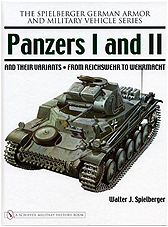
New
Panzers I and II and their Variants
Development - Production - Operations
This book in the series described the technical and
tactical development of these light tanks - from the Reichswehr years to the World War II campaigns in Poland, France and
Russia.
Hard Cover, 8.5" x 11", 160 pages, over 200 b/w photos, line drawings. Price:$49.95
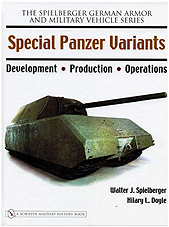
New
Special Panzer Variants
Development - Production - Operations This volume in the series is a collection of lesser-known German armor developments including the Maus, Hummel, Wespe,
Karl, Goliath and others. Hard Cover, 8.5" x 11", 160 pages, over 300 b/w photos, line drawings. Price:$49.95
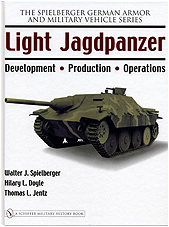
New
Light Jagdpanzer
Development - Production - Operations
This volume in the series presents the light tank destroyers of the Wehrmacht with accurate scale drawings
and previously unpublished photographs. Hard Cover, 8.5" x 11", 200 pages, over 300 b/w photos, line drawings. Price:$49.95
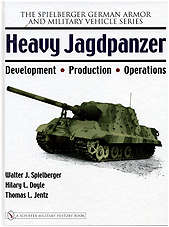
New
Heavy Jagdpanzer
Development - Production - Operations This volume in the series presents the Wehrmacht's heavy tank destroyers: Ferdinand, Jagdpanther and Jagdtiger with
previously unpublished photos and action reports. Hard Cover, 8.5" x 11", 200 pages, over 260 b/w photos, line drawings.
Price:$49.95
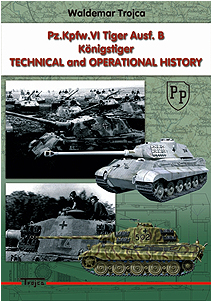
New
Pz.Kpfw.VI Tiger Ausf. B "Königstiger"
TECHNICAL and OPERATIONAL HISTORY
A new series of books on selected types of armor, ships and aircraft by Model Hobby. Each volume contains
a technical description of thes subject equipment along with CAD and 3D drawings, a separate chapter on its combat deployment
and an accompanying set of maps, organigrams (organizational structures) and camouflage/markings color plates (2D and 3D).
The series is spearheaded by a volume on Tiger Ausf. B, to be released in April 2007, featuring a hard cover binding, 400
pages, including 70 pages of comprehensive technical text, 100 pages of drawings, 40 organigrams (unit organizations at various
time periods), 160 photographs, 10 maps and 80 color plates, both 2D (camouflage patterns used by practically all units equipped
with the Tiger Ausf. B, including most of the tanks participating in operation Wacht am Rhein with s.SS-Pz.Abt. 501) and 3D
(all variants of the tank sporting various types of camouflage). The book contains a brief operational history of each Tiger
Ausf.B-equipped unit, enhanced with maps of selected combat engagements. Special emphasis is laid on the Waffen SS formations
(including s.SS-Pz.Abt. 101 and s.SS-Pz.Abt. 501) and several areas of deployment, such as the Ardennes offensive and the
fighting in Hungary during 1944-1945. Camouflage patterns, markings and insignia (if used), as applied by each unit, are also
presented. Price: $120.00
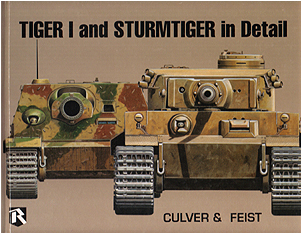
New
Tiger I and
Sturmtiger in Detail
Back by popular demand! Newly reprinted, this is the excellent follow-up to the original Tiger I in Detail.
Jam-packed with large clear photos of the big cat in action. Hard cover, wartime b+w photos throughout, with color plates.
Hard cover, 9" X 12", 170 pages b+w photos and color plates. Price: $45.00.
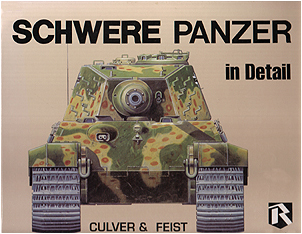
New
Schwere Panzer in Detail
Illustrated with over 400 b+w photos and drawings, color illustrations by Uwe Feist, and 5-view scale drawings
by John Rue this release from Ryton Publications has 170 pages of which 11 pages are in color. Printed on high quality paper
with attention to the clear reproduction of wartime photographs, depicting the King Tiger, Jagdtiger, and Elephant in combat,
training, and in numerous interior and exterior close-ups. Hard cover, 9" X 12", 170 pages b+w photos and color plates.Price: $45.00.
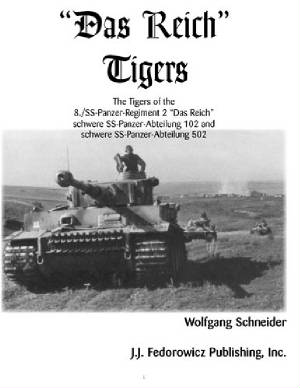
New
"Das Reich" Tigers
That's right, folks. Wolfgang Schneider has done it again!. This book will chronicle the Tigers associated
with "Das Reich" from the beginning to the bitter end: 8./SS-Panzer-Regiment 2; schwere SS-Panzer-Abteilung 102;
and schwere SS-Panzer-Abteilung 502. For the first time, this famous formation will receive a complete unit history
devoted entirely to it. While the photographic coverage of the "Das Reich" boys was exhaustive in Tigers in Combat 2, this
book will tie it altogether: Maps, historical overview, first-hand accounts and lots and lots of photos. While many of the
images have been seen before -- let's face it, virtually every known photo of the company and the battalion has been published
already -- it's the total package that will delight not only modelers, but also historians, armor buffs and collectors. 396 pages, 8 pages of color, several hundred photos, scores of maps, lots of first-hand accounts. (fed)
Price - $90.00
New
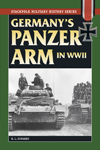
Germany's Panzer Arm in World War II
No twentieth-century military organization has been as widely studied as the German Army in World War II.
Nevertheless, there are almost no truly integrated studies that cover the organizational, economic, personnel, doctrinal,
and tactical factors that affected the panzer arm's performance. Drawing on German military documents as well as memoirs,
battle reports, and other materials, DiNardo fills that gap with this detailed examination of the panzer arm from the interwar
years through the end of World War II. Size: 6 x 9, 176 pages, 8 b/w photos.
(stackpole) Price - $16.95
New
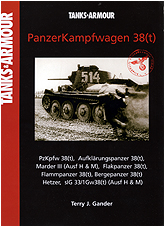
Tanks and Armour Panzer 38t
One of the most successful of prewar light tanks was the Czech LT-38 (TNHP). Built by CKD of Prague. A compact
and reliable vehicle, it was sold to Iran, Latvia, Peru and Switzerland and was also built under license in Sweden. After
the German annexation of Czechoslovakia in March 1939 all serviceable Czech tanks were absorbed into the German Army. Redesignated
the panzerkampfwagen 38(T), the Germans were well pleased with the LT-38 as, armed with a 37.2mm (SKODA A7) gun of good armor-piercing
performance, it was clearly superior to the Panzer I and IIs that formed the bulk of German armor at that time. In the battle
of France, the 7th and 8th Panzer Divisions were composed almost entirely of ex-Czech tanks; indeed during 1940-41 they formed
a quarter of all German tank strength. On the Russian front, it was completely outclassed as a gun tank but production of
the chassis continued as the basis of several improvised anti-tank self-propelled guns, such as the Marder III, and later
as the efficient tank destroyer, Jagdpanzer Hetzer. The gun tank continued to serve late into the war with armored train units;
the tanks being carried on flat cars for dismounted action against partisans. Soft Cover, 9 x 12, 96 pages, 170 b/w &
color photos. Price:$29.95
New
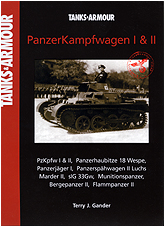
Tank and Armour Panzer I / II
On 27 July 1936, Adolf Hitler sent the Nationalists 26 German fighter aircraft. He also sent 30 Junkers
52s from Berlin and Stuttgart to Morocco. Over the next couple of weeks the aircraft transported over 15,000 troops to Spain.
In September 1936, Lieutenant Colonel Walther Warlimont of the German General Staff arrived as the German commander and military
adviser to General Francisco Franco. The following month Warlimont suggested that a German Condor Legion should be formed
to fight in the Spanish Civil War. Hitler gave permission and the initial force consisted a Bomber Group of three squadrons
of Ju52 bombers; a Fighter Group with three squadrons of He51 fighters; a Reconnaissance Group with two squadrons of He99
and He70 reconnaissance bombers; and a Seaplane Squadron of He59 and He60 floatplanes. After World War 1, Germany was forbidden
by the treaty of Versailles to possess or produce tanks. However, during the 1920s a variety of weapons, including AFVs, were
developed in secret and, with the connivance of the Soviet Union, were tested at Kazan in Russia. After the rise of Hitler,
rearmament was accelerated and plans were laid for the evelopment of purpose-built battle tanks that eventually emerged as
the Panzers III and IV.
As an interim measure, a vehicle was required for the training of the nascent armored forces and,
in 1933, prototypes of a simple, cheap and easy to manufacture tank were invited from a number of firms. A design by Krupp,
based on the Carden-Lloyd tankette, was selected and production began in 1934 under the code-name Landwirtschaftlicher Schlepper
or ‘agricultural tractor’. Later designated Panzerkampfwagen I it was 13ft long and weighed 5.4 tons, with a crew
of two. Armament was two 7.92mm machine guns and 3,125 rounds of ammunition were carried. In 1935 a further stopgap machine,
the Pzkpfw II, was produced, weighing 10 tons and armed with a 20mm Kwk 30 gun with a co-axial 7.92mm machine gun. Blooded
in the Spanish Civil War, these erstwhile training machines were numerically the most important tanks during the early campaigns
of World War 2 and their contribution to the success of Blitzkrieg warfare was considerable. Soft Cover, 9 x 12, 96 pages,
170 b/w & color photos.
Price:$29.95
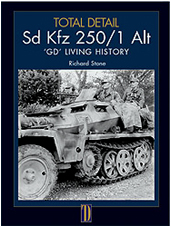
This book will re-define the use of reenactors and original vehicles from the war. The
author has gone to great lengths to research the history of GD’s reconnaissance battalion and particularly the 2nd company
who used the Sd Kfz 250 to re-create accurate both in detail and atmosphere non-combat scenes from the war. The lads who took
part, took this as a challenge right down to the pencil or packet of cigarettes in their pockets or the contents of their
rucksack and bread bags which were full of original items that would have been carried by a Wehrmacht soldier from GD. There
is even a chapter that uses the very same locations in Poland along GD's original retreat lines north up to Koenigsberg to
further add realism into the black and white section of the book. Highlights include: Over 300 PAGES, Over 250 black &
white photographs, Over 450 colour photographs Original Sd Kfz 250/1 alts, Original Sd Kfz 251/1 ausf D Original Kubelwagen,
The best living history GD re-enactors Detailed history of ‘GD’s reconnaissance unit, Detailed maps & archive
pictures, Uniforms & full infantry kit in colour, Ordnance section in colour, Incredibly realistic scenarios from detailed
research, Quick time ‘go to” colour reference finder throughout, Cross referenced to volumes 2 and 3, Translated
original ‘pay book’ pages. Rare and unusual items of interest. Price - $75.00
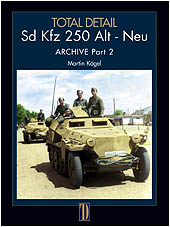
Total Detail Sd Kfz 250 alt Vol. 3: Archive Part 2 250 Alt - 250 NeuThe majority of the photographs in this book have never been published before, probably overlooked because
they have not caught any of the German ‘big cats’ in action. Nonetheless, they do contain an important visual
record of one of the ‘workhorses’ of the German ground forces, the Sd Kfz 250. This vehicle, in all of its variations,
played a vital and universal role for most of the war, and these photographs present it in context within several German armoured
formations, both at rest and in action. Surrounded by the mundane, the rare and sometimes the unusual, the 250 is followed
through the years, from factory fresh to battered veteran, set against the backdrop of Vichy France, Russia, Italy and Normandy.
As it is thought that the 250 factory records were destroyed during the war, it is difficult to offer precise information
such as dates for changes in chassis numbers or manufacturing differences. However, throughout the pages, an attempt has been
made to chronologically identify the sub-types of the ‘Alt’, the variations in the classic production models and
the design changes in the ‘Neu’, as well as observe rare prototypes and field modifications along the way. 240
pp., 200 pages of wartime photographs, A chapter of hand coloured wartime photographs on 18 pages to show the camouflage schemes.
24 pages of the original loading plan for all the 250 vaiants translated into English and laid as per the original book. Divisional
and tactical information along with historical background information. Uniform details. Price - $60.00
New
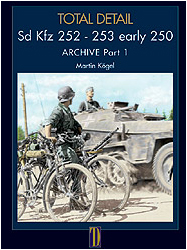
Total Detail Vol.3, Archive Part 1, 252 - 253 - 250 Early
Hard Cover, 260 pages in total, 190 pages of archive pictures, plus 10 pages of hand coloured photographs
to show the camouflage schemes and the original driver's manual translated into English and laid out as per the original book.
Wherever possible we have reproduced the pictures in an extra large format to give you all the detail you could want without
the need to use a magnifying glass! We have revised the design so the majority of photographs DO NOT span two pages if it
detracts from the image. Instead we have turned the photo on the page and added close up detail pictures and high contrast
details to show you what we think is interesting and important. (rzm) Price - $60.00
 New
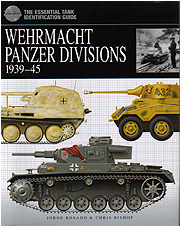
Wehrmacht Panzer Divisions
1939-1945
Illustrated with detailed artworks of German tanks and their markings with exhaustive captions and specifications,
"The Essential Tank Identification Guide: Wehrmacht Panzer Divisions 1939-45" is the definitive study of the equipment and
organization of the Wehrmacht's armored divisions. Organized by division, the book describes in depth the various models of
tank in German service during the war with each individual armored division, with listing of the unit commanders and any famous
tank aces. Each divisional section is further broken down by campaign, accompanied by orders of battle, a brief divisional
history of the campaign and any specific unit markings. With information boxes accompanying the full-color artworks, all drawn
to the same scale, The Essential Tank Identification Guide: Wehrmacht Panzer Divisions 1939-45 is an essential reference guide
for modelers and any enthusiast with an interest in the armored divisions of the German Wehrmacht. Size: 7 1/2" x 9 1/2",
Hard cover, 192 pages, 500 illustrations, 10 photos.Size: 7 1/2" x 9 1/2", Hard cover, 192 pages, 500 illustrations, 10 photos.
(rzm) Price: $34.95
New
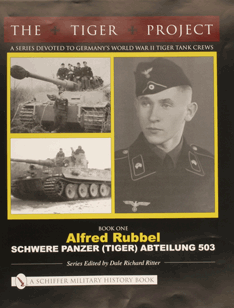
The Tiger Project: A Series Devoted to Germany`s World War II Tiger Tank Crews
This book is the first in a proposed series that will delve into the inner workings of Gremany`s most fearsome
panzers of the Second World War, the Tiger and Tiger II. There are many current books that deal with various aspects of the
Tiger series of tanks, but few include more than minimal biographical information of the men who crewed these battlefield
behemoths. Based mainly on interviews, personal diaries, and recollections, the series will present the Greman Tiger and King
Tiger crewmen as soldiers who had the opportunity to serve as a member of a crew and units that fielded a truly extraordinary
and deadly weapon. Size: 8.5"x11", illustrations; over 220 b/w photos, maps, 168 pages. Price - $49.95
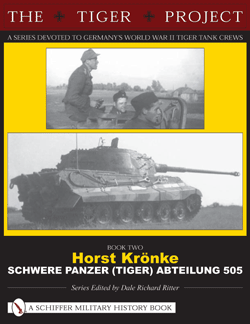
THE TIGER PROJECT - A Series Devoted to Germany’s World War II Tiger Tank Crews
As with the first book in this series covering the experiences of Alfred Rubbel (see page 55), this second
book is strictly the story of one man: Horst Krönke. The story combines the experiences of Krönke with approximately 400 photographs
(most which are unpublished), hand-drawn maps, and original documents, to tell the story of a veteran of Germany’s elite
panzerwaffe and feared Tiger tanks. His initial experience was in training with Panzer Ersatz Abteilung 5. From there he was
assigned to Panzer Regiment 6, of the 3rd Panzer Division and experienced the opening of the war in Russia. Krönke was in
action on the Eastern Front through the end of 1942 at which time he was sent back to Germany to attend officer cadet and
then officer’s schools. Upon his return to the front and Panzer Regiment 6 he was sidetracked by an old comrade and
was incorporated into schwere Panzer Abteilung 503. At that point Horst was introduced to the new Tiger tank and served with
a Tiger unit, transferring to schwere Panzer Abteilung 505 to serve with his brother, until the end of the war. Size: 8.5"x11",
over 400 photos and maps, 224 pages. Price - $49.95
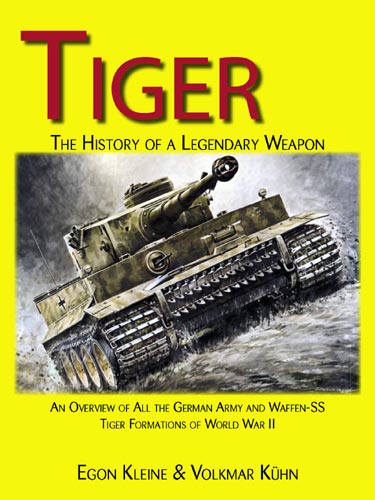
Tiger, The History of a Legendary Weapon
This is a reprint of a J.J. Fedorowicz Publishing classic on the Tiger I and Tiger II formations
of the German Army and Waffen-SS. Even though the English-language edition of “Tiger, The History of a Legendary Weapon”
is nearly 10 years old, it is still one of the best books written on the most feared tank of the Second World War. It is full
of first-hand accounts that cannot be found anywhere else. In addition, the text has been completely re-edited for this
reprint. Even if you own the original, you should consider the reprint. The book begins with the development history of
the Tiger and continues with its first introduction to battle near Leningrad. All the Army and Waffen-SS Tiger
formations and the major battles they fought in are covered, from sPz.Abt. 501 in North Africa, through the titanic
struggles on the Eastern Front, to the desperate fighting in the West and in Italy to the Waffen-SS Tiger battalions
in Hungary and ending with sPzAbt. 507 in the final battles in Germany. Also included are unit histories
of the Jagdtiger and Sturmtiger formations. Numerous first-hand accounts of combat in the Tiger are included
in the text which give the reader a vivid insight into the reality of fighting in these massive vehicles. The numerous excellent
photographs of the vehicles and their crews complement the text. This is a limited edition reprint so act quickly to secure
your copy. (The cover may be different than the draft pictured above.) Size: 9"x12", 390 b/w photos, 19 maps, 273 pages. (fed)
Price - $72.00
Funklenpanzer
The History of German Army Remote-and Radio-Controlled Armor Units
This book is to the radio- and remote-controlled units as the Combat History of the schwere Panzerjäger-Abteilung
653 book was to the Elefant and the Ferdinand. An absolute must for the discriminating armor fan - more than 800+ photos,
most of which have been previously unpublished. Besides never-before published photos of the demolitions carriers and the
mine-clearing vehicles, there are hundreds of great shots of the command and control vehicles: the kleiner Panzerbefehlswagen,
the Leitpanzer III, the Sturmgeschütz III and the Tiger. Size: 9"x12", 800+ photos, 32 pages of color with superb artwork
by Jean Restayn, 500 pages.(rzm) Price - $99.00
Panzerkrieg
An overview of German Armored Operations In World War II
Panzerkrieg — “armored warfare” — is an exciting recounting of the role played by
Germany’s armored forces in the epic fighting of World War 2. While the First World War saw the introduction of armored
warfare on a limited scale, it was the military visionaries who shaped and molded Germany’s fledgling armored forces
in the post-war period. They saw the potential inherent in this weapons system. Combined with the awesome potential of modern
airpower and an imaginative use of tactics, the German Panzertruppe almost enabled Hitler to accomplish his aggressive dreams.
This book presents the reader with a fascinating glimpse into the formation of this formidable force,
its initial unparalleled string of victories — often against numerically far superior foes who were armed with even
better equipment — and its inevitable downfall under the combined military might of the Western Allies and the Soviet
Union. In addition to providing the reader with an operational overview of all of the campaigns in which German armored forces
played a major role, Franz Kurowski also fills his text with innumerable personal profiles of the men who commanded these
steel monsters at the small-unit level. The reader thus gets a feeling not only for the broad sweep of
maneuver warfare at the operational level, he also gets a glimpse from inside the turret by the men who fought from them.
Much of the narrative concentrates on the early-war years, when the application of the Blitzkrieg doctrine achieved one decisive
victory after another. Although the classic use of armor as a force multiplier in an offensive role became less and less pronounced
as the war progressed, the author also covers the final years of the war, where the Panzertruppe became increasingly relegated
to the role of a “fire brigade” at the hot spots of the fighting. While different aspects
of this subject have been covered in other titles, it is rare to find one book which not only captures events at an operational
level but also provides the reader with the “human” side of the clash of steel. Size: 6"x9", more than 175
photos and maps, 694 pages. (rzm) Price - $66.00
Tigers in Combat I
By the end of World War II, the dreaded Tiger tank had achieved
mythical, almost mystical status. In this much-sought-after volume on the Wehrmacht's numbered Tiger units, Wolfgang Schneider
tells--in pictures--the story of these renowned tanks. Hundreds of photos depict Tigers in all situations and terrain, and
a section of painstakingly detailed drawings brings the tanks to life in the metallic grays, snow whites, desert tans, and
forest greens and browns that colored them. Modelers and buffs alike will delight in this impressive collection. Size: 8.5"x11",
375 b/w photos, 30 color illustrations, 320 pages.PB (stackpole) Price - $29.95
Tigers in Combat II
In this follow-up to Tigers in Combat I (0-8117-3171-5),
Wolfgang Schneider turns his attention to the Tiger tanks of the Waffen-SS and the Wehrmacht's "named" units, such as the
Groádeutschland Division, Company Hummel, and Tiger Group Meyer. Based on combat diaries, the text tells the history of each
unit, but most of the book is devoted to photos of the tanks and the men who manned them. It offers as unique and comprehensive
a look at these lethal machines as is possible sixty years after World War II. Size: 8.5"x11", 450 b/w photos, 32 color illustrations,
384 pages. PB (stackpole) Price - $29.95
INSIDE THE TIGER 1
With this new volume, Jean Restayn finishes up his trilogy
on the most famous German tank of World War Two. After having dealt in detail with the Tiger tank units on both Eastern and
Western fronts (the two previous volumes), this author/illustrator of worldwide reputation now delves into the lesser known
aspects of the Tiger I tank. Every conceivable interior and exterior construction detail is covered here together with a detailed
analysis of the environment on the Tiger combat units: refuelling, ammunition, recovery, field repair, etc. Appealing to all
kinds of tank enthusiasts, this huge documentary work will also to be the ultimate tool for model builders. Size: 10"x12.5",
illustrations in color throughout, 144 pages. (casemate) Price - $45.95
Sledgehammers
Strengths and Flaws of Tiger Tank Battalions in World War II
Sledgehammers] takes a refreshing approach to the topic of Tiger tanks, the
author does his homework, he writes well enough, and he remains very even-handed in his descriptions of Tiger battalions in
action and in his assessment of their effectiveness. Overall, this book should favorably impress most readers, and it's probably
the sort of obscure classic that will remain very much in demand over the years by armor enthusiasts in general and Tiger
buffs in particular. Recommended." Size: 6"x9", 42 photos, 35 original maps, 272 pages. Soft cover. (aberjona) Price - $19.95
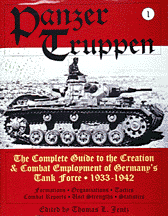
Panzertruppen
The Complete Guide to the Creation & Combat Employment of Germany's Tank Force-1933-1942
In September of 1939, the world was astounded by Germany's ability to defeat Poland in less
than a month. With the world still puzzled by the suddenness of this event, Denmark, Norway, Holland, Belgium, and France
fell in rapid succession to the German onslaught, leaving Britain in shock. Greece and Yugoslavia were rapidly over-run during
April of 1941, while German-Italian forces advanced rapidly in North Africa. Russia's turn was next, when German forces began
pulverizing their forces in June of 1941. How had Germany achieved victory after victory, often against numerically superior
enemy forces? The answer came in two words-Panzer and Blitzkrieg. When and how had Germany built its Panzer forces and trained
them for the Blitzkrieg? When was each Panzer unit formed? What was their organization? Why were Panzer units disbursed among
the Panzer-Divisions. leichte Divisions, and Armee-Korps? When were the various types of Panzers developed? What were their
armament, armor protection, capability? How many of each type were produced? What tactics did they use? How successful were
they in combat? This is the only book that provides detailed answers to these and other questions related to how German tankers
fought in World War II. Tom Jentz found the answers to these questions bu digging through original records for the past tweny-five
years. The content os this book is derived solely from these original records consisting of war diaries, reports, and technical
and tactical manuals written during the war. The story is told as recorded by those responsible for decisions in developing
the Panzertruppen and by those who fought in the Panzers. As work on this book progressed it became apparent that the story
of the Panzertruppen was divided into two distinctly separate phases; offensive and defensive. This first volume presents
the offensive phase up to October 1942. A second volume is planned that will cover the defensive phase to the end of the war.
Tom Jentz is also the author of Germany's Panther Tank: The Quest of Combat Supremacy. Size: 8.5"x11", over 200 b/w photos,
288 pages. Price - $49.95
ARMOURED VEHICLES AND UNITS OF THE GERMAN ORDER POLICE (ORDNUNGSPOLIZEI) 1936-1945
This
is the first detailed history of the armoured vehicles used by the German order police during WWII. All armour types are discussed
and shown in period photographs, including details of paint schemes and markings. Though the emphasis here is on the armoured
vehicles, there is also an in-depth look at combat operations on a variety of war fronts, uniforms, equipment, and unit-by-unit
histories 288pp. over 300 b/w photos and charts. Price - $67.35
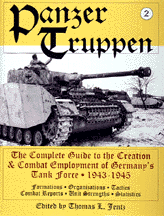
Panzertruppen 2
The Complete Guide to the Creation & Combat Employment of Germany's Tank Force - 1943-1945/Formations
- Organizations - Tactics Combat Reports - Unit Strengths - Statistics
This companion volume presents how the Panzertruppen fought during their defensive struggle
with details on the units, organizations, types of Panzers, and tactics. Size: 8.5"x11", 47 b/w photos, maps and charts,
304 pages. (SCH) Price - $59.95
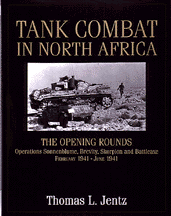
Tank Combat in North Africa
The Opening Rounds Operations Sonnenblume, Brevity, Skorpion and Battleaxe
The focus of this book is the tank battles fought during the opening phase of the war in North Africa. What
really happened during the engagements? How were the tanks fought? What were their strengths and weaknesses? Not simplified
generalities, but substantive, basic facts gleaned from searching for details in the surviving original records. The accounts
of each battle are excerpted from the original reports written by the participants directly after each engagement. To understand
the basis for the outcome of the battles, it is necessary to possess a basic understanding of the capabilities of each type
of tank, its opponents, and how they were tactically employed. The first five chapters in this volume provide descriptions
and technical attributes of the British, German, and Italian tanks and anti-tank guns along with the tactical doctrine from
the period. Chapters six through eleven contain the details of the tank battles fought in North Africa during the period from
February 1941 to June 1941. Translated excerpts from the Deutsches Afrikakorps war diary are used as a backdrop to provide
a chronological guide as events progressed. An interesting feature from this war diary was the brief daily weather report
revealing how hot it was and when sand storms occurred. Details on the actions in the tank battles are taken from after-action-accounts
written directly after the engagements, enhanced by excerpts from war diaries of the armoured units involved to fill in the
preliminary moves, buildup of strength, combat losses, and details on the actions that weren't contained in the after-action-reports.
This book is compiled from the results of digging through original records for over thirty years in an attempt to find data
that would aid in assessing and understanding the tank battles that took place in North Africa. Size: 8.5"x11", over 100 b/w
photos and line drawings, 256 pages. Price - $49.95
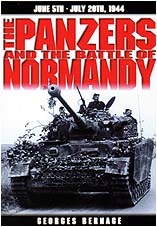
New
The Panzers and the Battle of Normandy
On June 6, 1944 the Allies landed in Normandy, faced by one poorly equipped armored division, even though
field Marschall Erwin Rommel had originally intended to throw the invaders back into the sea on the first day. The Following
day, only 2nd Panzer Battalion of the "Hitlerjugend" Division arrived as a reinforcement and the failure of its counter-attack
towards the coast allowed the advance of the Canadians. The 8th and 9th of June saw further defeats for the Panzer tanks of
the same division. The tanks of the Panzer Lehr Division then arrived, but by that time the Allies had been considerably strengthened
and the new German Counter-attack failed to get off the ground. Henceforth, the panzers could only be engaged in a defensive
capacity to ward off the Allied attacks. Three fresh German armored divisions entered the line at the end of June, but by
then it was already too late. Cherbourg and Caen fell into the hands of the American and British forces. The panzers were
knocked out one by one in these defensive battles and the losses could no longer be replenished. Having contained the Allies
for more than six weeks, the panzer divisions were unable to prevent the rupture of the German front at the end of July 1944.
This generously illustrated book examines those six decisive weeks during which finely-engineered tanks manned by well-trained
and highly-motivated crews managed to slow down the Allied advances. This book shall be an indispensable document for all
those who wish to understand why the Battle of Normandy lasted as long as it did. Hard cover, 8"x10", 168 pages, 250 photos,
32 pages of full color, 27 detailed maps, English text! Price - $39.95 (Heimdal)
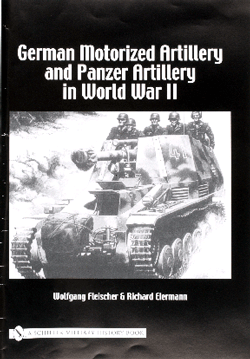
German Motorized Artillery and Panzer Artillery in World War II
With over 260 images, this new volume is a concise, illustrated history of Germany’s
World War II artillery, its units and operations. Photos include both the towed and self-propelled weapon types. Also included
are detailed unit organizational charts and line schematics of artillery rounds. Size: 7"x10", over 260
b/w photos and line drawings, 160 pages. Price - $35.00
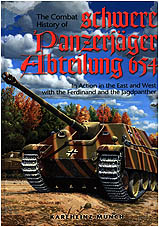
The Combat History of Schwere Panzerjager Abteilung 654
In Action in the East and West with the Ferdinand and the Jagdpanther
The complete battle diaries of the battalion are provided and complement the text which covers the unit
from its formation through its receipt of the Ferdinand and its fighting at Kursk and, later, the Jagdpanther and its employment
in the West. More great Ferdinand photos and, if you tried of seeing the same old photos of the Jagdpather, this book will
be especially enjoyable for you. There are at least 100 photos of the rare beast, of which about 90% are previously unpublished.
Hard cover, 200 pages, 50 diagrams, 40 pages of color artwork and more than 700 photos, most of which are previously unpublished
and a great many deal with the Ferdinand and the Jagdpather. Price - $99.00
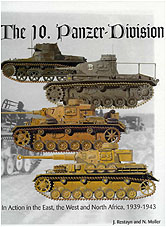
The Combat History of the 10. Panzer Division, In Action in the East, West and North Africa 1939-1943
This photo album presents the history of the division through a brief text, hundreds of photographs, several
maps and numerous custom color illustrations. This book offers the first account in English of this battle-proven division,
which was formed shortly before the outbreak of the war. It fought in Poland, France and in the opening stages of the campaign
in Russia. In mid-1942, it was pulled out of the line, reconstituted and reorganized in France and then sent to North Africa
as part of Hitler`s desperate attempt to save the situation there. Although the division spent only six months in the desert,
it fought both the British and the Americans. it gave the "green" American Army a bloody nose in some of its first encounters
with the Germans, including the legendary fighting at Kasserine Pass, before it had to bow to defeat and capitulation at Tunis
in May 1943. Although the division had a proud and successful history, it was never reconstituted. Size: 9"x12", 350
pagesof color and hundreds of terrific B/W photographs. Price - $90.00
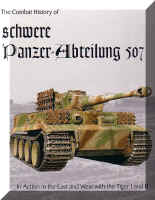
The Combat History of Schwere Panzer-Abteilung 507.
In Action in the East and West with the Tiger I and Tiger II. Schwere Panzer-Abteilung
507 was formed in late 1943 using cadre provided from Panzer-Regiment 4 of the 13. Panzer-Division. In early 1944, it was
sent to the Eastern Front, where it successfully participated in a number of defensive efforts as a mobile "fire brigade."
In early 1945, it was sent to Paderborn for reconstitution. There it was being refitted with the Tiger II, when it was hastily
attached to SS-Panzer-Brigade "Wesfalen" for the defence of the Paderborn area. Equipped with a wide variety of fighting vehicles,
incliding the Jagdpanther and Jagdtiger, it successfully engaged American forces of the 3rd Armored Division southwest of
Paderborn, before it was pulled further back to the east. One of the few combat losses of US general officers during World
War II - Major General Rose, the commanding general of the 3rd Armored Division - Was in an engagement with the Battalion.
After losing the remainder of its tanks to combat activity or their forced transfer to SS forces, the battalion moved to Czechosiovakia,
where it was again issued combat vechicles, including the Hetzer tank destroyer, where it spent the final days of the war
trying to surrender to Western Allies. In the end, the battalion was handed over to Russian forces, where many of its members
spent long years in Russian captivity. If you enjoy this type of reading matterial, you`ll be sure to enjoy the other histories
of the Tiger Battalions we offer - The Combat Histories of Schwere Panzer Abteilung 503 and Schwere Panzer Abteilung 508.
Hard cover, large format, size 9"x12", 223 pages with 11 pages of color illustrations, one page of color photographs and more
than 150 additional illustrations and period photographs. Price - $66.00
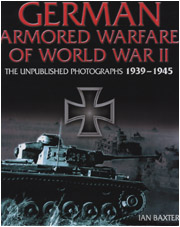
German Armored Warfare of World War II The unpublished
Photographs 1939-1945
Starting with the Biltzkrieg period, when Nazi Germany unleashed its mobile armored divisions into Poland
and the Low Countries, German Armored Warfare of World War II captures the full might of the Panzerwaffe, Hitler`s Panzer
arm, from its early triumphs to its final demise. Featuring previously unpublished photographs, many of which have come from
the albums of individuals who experienced the war firsthand, the book presents a unique and vivid record of German armor in
action from 1939-1945. The photographs detail in turn the different elements that went into making up a fully fledged Panzer
division: light tanks, main battle tanks, artillery, assault guns and anti tank destroyers, reconnaissance units, support
vehicles, and of course the Panzergrenadiers. In depth descriptive captions accompanying the photographs also provide much
historical information and facts about the events portrayed. Depicting action from the fields of France to the Russian steppes
and rugged Italian terrain, German Armored Warfare of World WAr II is a captivating glimps of one of the most effective weapons
of war ever to have appeared on the battlefield. Size: 9.5"x11". hard cover, 224 pages, B/W photographs throughout with detailed
captions.
Price - $34.95
;'';
|
|
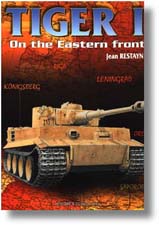
Tiger I On the Eastern Front
In April 1941, two months prior to operation 'Barbarossa,' Adolf Hitler ordered the development of a heavy tank, armed
with the famed 88mm gun. This tank became a legend in its own time. Feared by its adversaries and liked by its crew, the Tiger
etched its mark in history and the legend carries on, 50 years after the end of the war. 'Tiger I in the East' depicts with
more than 500 photos-mostly from new sources-and more than 400 color plates, the markings, insignia, camouflage of the most
famous German tanks. A short history of all Tiger units who faced the Red Army is also featured. Size: 9 3/4"x12 1/2", 144
pages. (casemate)Price - $59.95
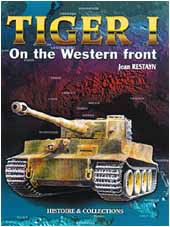
Tiger I On the Western Front
This brand new title from H&C is the companion to the successful "Tiger I on the Eastern Fromt". Full of unique wartime
photos and beautiful color plates and illustrations this title details the infamous Tiger I tank as it performed in France,
Germany and North Africa against Allied Forces in WW II. Topics include: Schwere Panzer-Abteilung 501,503,504,508, Schwere
SS-Panzer Abteilung 101, and 102 as well as Panzer-Abteilung (Fkl.) 301. Also includes excerpts from official German reports
and documents. Size: 9"x11", 144 pages, hundreds of B/W combat photos, and detailed color plates.(casemate) Price - $59.95
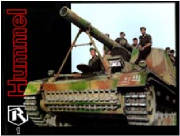
The Hummel
The "Hummel" (Bumble Bee) was one of the most popular self-propelled artillery pieces used by the German Army in WW II.
Hundreds of beautiful wartime photos show the Sd.Kfz.165 from the production lines at the Deutsche Eisenwerke factory in Duisburg
Germany to combat in Russia in 1943. In addititon to these period photos, the book also contains color photos of a beautifully
restored Hummel at Panzermuseum Munster to illustrate the correct paint color and camouflage schemes. This coupled with
extraordinary captions by Robert Johnson and detailed photos of the 15cm howitzer, chassis, and Hummel crews in action, make
this a must-have for all German armor modelers. Size: 8"x11", 63 pages, B/W wartime photos, color photography. Price - $18.00
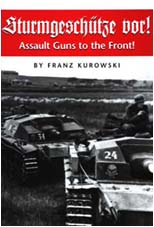
Sturmgeschutz vor: Assault Guns to the Front!
This impressive new title from J.J. Fedorowicz Publishing details the history of the independent Sturmgeschutz-Battaillione
and Brigaden, using unit war diaries and many first-hand accounts. Includes many rare and unpublished photos as well as 16
pages of terrific color plates by Jean Restayn. Size: 12"x9", 350 pages, 300 + photos. Price - $75.00
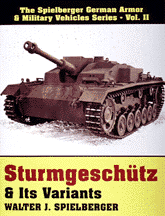
Sturngeschütz & Its Variants
The first two volumes of this definitive history of German armor are now available in English! Known for its emphasis
on detail, the Spielberger series shows in factory, test and combat photographs, and detailed line drawings, all production
models, prototypes and modifications of specific armor and military vehicles. Volume I covers all variations of the "Panther"
tanks, including all vehicles that used the Panther chassis. Volume II on the Sturmgeschutz assault guns, shows all short
and long gun versions, as well as the various support vehicles of the Sturmartillerie. Upcoming volumes include: Volume III
on the Panzer IV, and Volume IV and the Panzer III. Size: 8.5"x11", over 240 photos, 256 pages. Price - $49.95
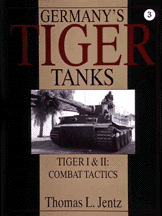
New Germany`s Tiger Tank
Tiger I & Tiger II: Combat Tactics
This brand new volume covers the complete combat history of the Tiger I and II, and includes the operational charactistics,
organization, tactics, issue to combat units operarional strenght reports, and after-action-accounts. Over twenty years of
intensive research went into finding the orginal documents needed to create this new history on the development, characteristics,
and tactical capabilities of the Tiger series. Exhaustive search for surviving records of the design/assembly firms (Including
Henschel, Krupp, Nibelungenwerk, Porsche, and Wemann), the Heereswaffenamt, the D656 series of manuals on the Tiger, and the
war diaries and operations reports from the German units. Size: 12"x9", 176 pages, over 130 B/W photos, 50 charts and drawings.
Price - $49.95
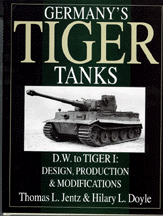
Germnay`s Tiger Tank D.W. to Tiger I
Design, Production & Modifications
This first volume, of a three-volume set, covers the history, development and production history of the Tiger
tank variants from the idea`s conception to the end of Tiger I production. This includes details on the development series
known as the D.W., VK 30.01(H), VK 30.01(P), VK 36.01(H), VK 45.01(P) as well as the Tiger I. All of this illustrates with
scale drawings by Hilary L. Doyle, combined with drawings, sketches, and photographs depicting external modifications as well
as internal views. Over thirty years of intensive research went into finding the orginal documents needed to create this history
of the development, characteristics, and tactial capabilites of the Tiger. Size: 9"x12", over 160 B/W photos, 151 line drawings,
pages 192. Price - $49.95
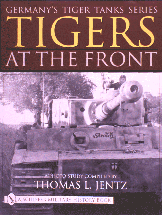
Tigers at the Front
Tiger! The very name that Allied troops feared. It came to symboloze the superiority of German tank design. This book
has been created as a photo essay showing the best available and rare photographs of Tigers with units at the front. No tank
that the Allies fielded in World War II was comparable to this combination of the 88mm gun with massive armor protection.
Allied tankers didn`t think that they stood a chance of defeating these formidable Tigers. They only hoped that these heavy
tanks would breakdown, become immoblized in soft ground, or be damaged by lucky hits on vulnerable points. Size: 8 1/2"x11",
over 270 B/W photos, 208 pages. Price - $29.95
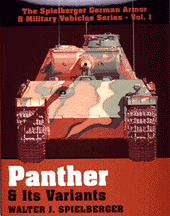
Panther & Its Variants
The first two volumes of this definitive history of German armor are now available in English! Known for its emphasis
on detail, the Spielberg series shows in factory, test and combat photographs, and detailed line drawings, all production
models, prototypes and modifications of specific armor and military vehicles. Volume I covers all variants of the "Panther"
tank, including all vehicles that used the Panther chassis. Volume II on the Sturmgeschutz assault gins, shows all short and
long gun versions, as well as the various vehicles of the Sturmartillerie. Upcoming volumes include: Volume III on the Panzer
IV, and Volume IV and the Panzer III. Size: 8 1/2"x11", over 460 photos, 288 pages. Price - $49.95
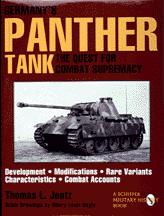
German`s Panther Tank - The Quest for Combat Supremacy
Over 20 years of research went into the creation of the history of the development, charateristics, and capabilities
of the Panther.
Size: 8 1/2"x11", over 170 B/W photos, line drawings, 160 pages,
Price - $49.95
Panther in Detail
This new release from Ryton Publishing covers all aspects of the Panther Tank, all productions models are shown including
the Bergpanther recovery vehicle. It has brilliant color plates drawn by Uwe Feist, along with an excellent mix of wartime
and present day museum shots. This is an excellent book that modelets will crave. Size: 9"x12", 181 pages. Price - $40.00
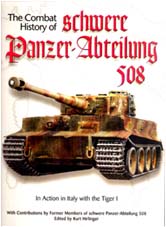
The Combat History of Schwere Panzer-Abteilung 508This New title from JJ Fredorowicz
Piblishing details the heavy tank battalion 508 as it saw combat in Italy with the Tiger I. This unit history was composed
by actual surviving members of the unit. Divided into sections-headquarters company, maintenance company, and the three tank
compaines, this book contains the memories of those who were with the battalion when it formed thru combat in Italy and finally
Germany. the text is enhanced with all the photographs from the orginal German edition, plus approximately 100 more from a
variety of sources from around the world. In addition, this volume has 10 pages of color artwork by the internationally
known military vehicle artist, Jean Restayn. Size: 9"x12", 188 pages, 199 photographs, 6 pages of unit organizational diagrams
and 10 pages of color artwork. Price - $50.00
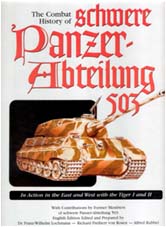
The Combat History of Schwere Panzer-Abteilung 503
In Action the East and West with the Tiger I and II
This is the first unit history of the Tiger Battalions from Fedorowicz Publishing. it features lots of first-hand accounts
of this, the senior Tiger battalion of the German Army. Schwere Panzer-Abteilung 503 was formed in the late 1942 and fought
until the bitter end on both the Eastern and Western Fronts. It was issued with both the Tiger I and Konigstiger (with both
the Henschel and Porsche-turrets). Besides an exciting text, this volume also features 190 photo pages with nearly 300
photos, a good percentage of which have never been published before. With contributions by Schwere Panzer-Abteilung 503 Veteran`s
Association. Size: 9"x12", English text, 400 + pages, 190 photo pages. Price - $88.00
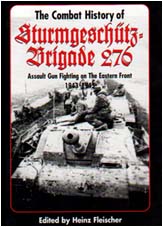
Sturmgeschutz Brigade 276
This new title from Fedorowicz Publishing tells the dramitic story of the assault gun soldiers of the Sturmartillerie
on the eastern front in WW II. Sturmgeschutz Brigade 276 was one of the many battalions formed to fight the onslaught of the
numerically superior Soviet forces, and to provide armored protection for the German infantry. This history is written entirely
in the form of first hand accounts by members of the former battlion. As such, the reader is drawn into the world of the assault
gunner, where cunning and tactical expertise were needed to slug it out with superior numbers of Soviet tanks. Size: 6"x9",
306 pages, 145 combat photos, 10 course-of-action sketches and three scale drawings. Price - $46.00
Sturmgeschutz III
This exciting new title in the Ryton series on German Armor, has been several years in the making. It contains text by
the renowned German historian Wolfgang Fleischer and hundreds of rare b/w wartime photos and modern color photos of the step
by step restoration of a Sturmgeschutz III, Ausf. G. Much like the prevoius Ryton volumes on the "Tiger I" and "Panther"
which are now out of print, a special Limited Edition series is available signed and numbered by the authors. It also contains
a personally signed lithograph portrait of Leutnant Dr. Alfred Regeniter, holder of the Ritterkreuz des Eisernen Kreuz, a
former Kompanie commander of the 3./St.,Gesch.Brig.276, while fighting on the Eastern front. Size: 8 3/4"x11 3/4", 264 pages,
560 photos, 4-view scale drawings by John Rue. Price - $75.00
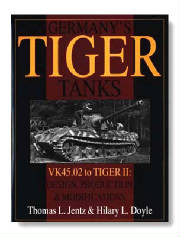
Germany`s Tiger Tank
Design, Production & Modifications VK45.02 to Tiger II
Over twenty years of intensive research went into finding the orginal documents needed to create this new history on
the development, characteristics, and tactical capabilities of the Tiger series. Tom Jentz has condicted an exhaustive search
for surviving records of the design/assembly firms (including Heschel,Krupp, Nibelungerwerk, Porsche, and Wegmann), the
Heeres-Waffenamy, the D656 series of manuals on the Tiger, and the war diaries and operation reports from the German units.
The written records were supplemented by examining thousands of photos. On-sight research into almost all the surviving Tigers
provided details that could only be obtained from actual specimens. Size: 9"x12", 120 B/W photos, over 130 line drawings.
Price - $49.95
|